

Intermittent Fasting Protocols and Muscle Sparing

closed297

Registered
Well Done !
Joined
Jun 24, 2020
Messages
444
Reaction score
1
Points
0
Bottomline the guy improved his health but did he lose muscle yes he did, lost a lot of fat also. Now remember he lost muscle despite starting gym for the first time .

Pretty common for an amtuer attempting the gym.. (Not to sound condescending but that's usually dietary related)
Provided his hormones are normal.

The problem I have is people keep saying you wont lose muscle even doing a great deal of this .

I tend to agree with you on this one in terms of i struggle to see how not providing nutrients for extended periods of time can be beneficial to any progression..
Notice i didn't say maintenance i said progression..
There is some science that suggests there is ample calories in the bank when you fast..
I mean drug addiction is a perfect example of involuntary fasting and i don't know about you.. but i'm yet to meet many healthy strong drug addicts..
But i think yogi is trying to say when it's controlled its produces different results..( The article takes the same view)

But my opinion would also be formed from the avergae amatuer attempting this method rather than an experienced trainer or athlete..

I wouldn't discredit any method if done correctly (which it sounds like your mate just stopped eating?)

Did you have a specific routine he used to achieve his let's assume weight loss (not fat)?

Some other information worth throwing out their for the sake of OP discussion.. (Again simple search google quotes)

How long can you fast before you lose muscle?

The best way to get an answer is to put people on a fast and measure their lean body mass. Some people have claimed that every fast over 24 hours burns 1/4 to 3/4 of a pound of muscle.

Will you lose muscle on a 3 day fast?

Recent clinical evidence bears out the fact that repeated fasting does not cause muscle loss. In a 2010 study of alternate daily fasting, patients were able to lose significant fat mass with no change in lean mass. In this schedule, subjects eat normally on feeding days, and alternate that with a day of fasting.

Do you lose fat or muscle first when starving?

Ordinarily, the body responds to reduced energy intake by burning fat reserves and consuming muscle and other tissues. Specifically, the body burns fat after first exhausting the contents of the digestive tract along with glycogen reserves stored in liver cells and after significant protein loss.

Does water fasting burn fat or muscle?

May lose the wrong type of weight

Because a water fast restricts calories, you will lose a lot of weight quickly. In fact, research shows that you may lose up to 2 pounds (0.9 kg) each day of a 24- to 72-hour water fast ( 7 ). Unfortunately, a lot of the weight you lose may come from water, carbs, and even muscle mass.

The jury is out with google... Won't commit either way..

It's an interesting topic for sure...

Looking forward to some controlled scientific evidence (fingers crossed one day)..


Last edited:

Pegasus

Administrator, PE Gym Editor, PEGym Hero; ,
Staff member
Excellent !
Joined
Jul 15, 2009
Messages
44,283
Reaction score
1,164
Points
133
My friend lost a lot of fat my point was he also lost muscle

According to the dexa people experienced athletes lose muscle when they try to diet too fat and that includes fasting .

So anyway what Yogi is saying is that some protocol can be more efffective for muscle retain than others . So I look forward to hearing what are the most effective methods .
 

madyogi

Moderator, Member of the Month April 2020, PEGym
Joined
Feb 20, 2020
Messages
1,179
Reaction score
42
Points
68
Location
Arkansas, USA
What is fasting anyway ?

If I go back to my childhood people regularly "fasted" for 12hr so they had dinner at 7pm and breaky at 7am that was a normal day for most people , an 18hr"fast "would have been missing a meal. People would have only considered it fasting if it went more than a day .

In a sense this IF stuff is just geting back to th way our grandparents ate .

Yes, and in many ways it goes back even further than our grandparents, as you've already pointed out.

Look I just want to say here my experience is that it is not only money that bends science , ideaology does also .

This is true. However, just saying this doesn't invalidate all science. This is also why I tend to like meta-analyses, because they usually look at dozens of studies, and at least in theory that should circumvent some of the issues related to funding and ideology (confirmation bias).
 
Last edited:

madyogi

Moderator, Member of the Month April 2020, PEGym
Joined
Feb 20, 2020
Messages
1,179
Reaction score
42
Points
68
Location
Arkansas, USA
Why would one study the long term effects of this? (asking because is it a realistic thing to expect conclusive results?)
Also wouldn't it be extremely subjective to the length of fasts...
The amount of nutrients available from previous dieting (how full they are).
The average calorie intake prior to fasting
The speed of their metabolism <-- i'm assuming this is crucial

What i'm getting at is a "study" like this would have so many variables (like most dietary studies) as you have stated in previous threads nutrition is extremely subjective and adverse for many reasons (age,hormones,metabolism,activity,diet,goals,gender to name a few)

I think you missed my point here. The point I was making was specific to the study posted by Pegasus, which looked at the day-to-day utilization of structural protein for fuel. My point is that the body utilizes structural protein for fuel every day at different rates. Does a 36 hour fast increase this amount in the short term? Yes, it would appear so. But the body is constantly recycling itself, so I'm not interested in the day-over-day differences as much as I am in the month-over-month differences. And I don't particularly expect to find a study of such things, because that would be enormously expensive. So what I tend to do is look at various sources, try to make an educated hypothesis, then put it to work in my own life and check the results.

And for the record, I think you put too much emphasis on genetic variability and people having slow metabolisms. I'm sure, for particular people this is something to compensate for, but by and large, the "average" person will respond in a predictable way to most interventions.

I've personally when bulking (This is advice from a professional bodybuilder) purposely eaten oatmeal before sleeping to assure optimal protein synthesis..
Purposely utilising the slow release carbohydrates and protein..

The reason i mention this specifically if one was to eat something similar than this prior to fasting the nutrients would linger for hours depending on the subject..
So how close are these "studies" going to get?

This is a great point. If maximum muscle gain over time is your goal, I probably wouldn't recommend IF protocols. I might even recommend feeding in the middle of the night, though that would interfere with sleep, which has its own downstream effects.

And again, I'm not holding out for the perfect study. I'm just looking at what's available and trying to make an educated guess as to whether my core claim holds up.

I don't disagree that it cannot be used to benefit one's health (fasting)..But i also think it isn't necessary..

If you specifically want to know if you CAN do it because you WANT to while maintaining muscle mass there are PLENTY of people who do it and would take your side in this discussion and promote its use. Some even suggest (and certified) that it promotes muscle strength..

I just fail to see why you HAVE too (If you like it then why not).. i won't deny many use it and get positive results..

Again, I'm not making the claim that you HAVE to. I'm simply making the claim that you CAN without necessitating the loss of lean muscle mass. So, it seems we agree here.

Question: Do you personally partake in it because you get other positive effects? Or is it strictly because you see better results?

It's mostly a lifestyle choice. Before I started experimenting with IF, I was basically doing the standard eat every four hours to keep your metabolism running thing, and it wore me out. I was also counting calories at the time, which was an extra layer of inconvenience. I found Brad Pilon's book Eat Stop Eat around that time, and gave IF a shot. I found that I could do one or two fasts a week, have a cheat day once a week, then eat sensibly the rest of the time, and I never really had to think much about my diet.

Many would say there are other positive physiological effects, but the science is very much still shaky on those claims. For me, it's a lifestyle that works.

I'm not saying it's the ONLY way to go, or the BEST way to go in every situation, but it has worked for me. And it might well be the best approach when it comes to caloric restriction with the express goal of losing weight fast (perhaps better than daily restriction). Again, my core argument is simply that you CAN do something like this without net loss of lean mass over time.

Here's a link if allowed to an example of someone who fasted to positive results.. And recorded the results..

https://www.t-nation.com/diet-fat-loss/john-berardis-great-fasting-experiment (if its not let me know and il copy paste the text instead)

He's also a doctor and a bodybuilder if that helps credify the experiment..He also promoted with the experiment on his clients on top of his own body.

Cool, thanks for the added reference.
 
Last edited:

madyogi

Moderator, Member of the Month April 2020, PEGym
Joined
Feb 20, 2020
Messages
1,179
Reaction score
42
Points
68
Location
Arkansas, USA
Actually fasting is a very old concept . It is the IF version that is relatively new and like I said you don't have to go back very far and it would be considered a normal day .

I actually think it can have health benifits . The problem I have is people keep saying you wont lose muscle even doing a great deal of this .

We agree here for sure, and as we have established, the word "fasting" is a broad umbrella. Wild claims about extended fasts to lose weight without compensating for the lean mass loss that will surely come are to be dismissed at this point.

Finally, for now, I'll sum up my interests in this thread as being two fold:


  1. To establish that just because Intermittent Fasting has the word "fasting" in it doesn't mean all IF protocols will lead to muscle tissue loss over time, and further it is possible to gain lean mass while utilizing certain protocols in certain ways.
  2. To understand which protocols are most likely to be successful in sparing or even gaining muscle mass over time.

In the interest of investigating these two items, I'm planning to do an n of 1 experiment probably starting after Labor Day. I found a spot in town that will do a DEXA scan for $50 the first time, then $35 for each additional scan. I have to call and check on their availability during COVID, but what I'd like to do is get a scan in early September, then log my exact protocol for ~8 weeks, then get a scan again right before Thanksgiving.

After the weight loss challenge ends on August 24th, I'm planning to go into more of a hypertrophy centered program in terms of exercise to consolidate my weight loss and further improve my body composition. It would be a perfect time to put my theory to the test, at least as an anecdotal case.
 

closed297

Registered
Well Done !
Joined
Jun 24, 2020
Messages
444
Reaction score
1
Points
0
I'm simply making the claim that you CAN without necessitating the loss of lean muscle mass. So, it seems we agree here.

Maybe an unpopular view but i don't buy into the whole "lean muscle mass" "fat muscle mass" to me muscle is muscle and fat is fat..

After the weight loss challenge ends on August 24th, I'm planning to go into more of a hypertrophy centered program in terms of exercise to consolidate my weight loss and further improve my body composition. It would be a perfect time to put my theory to the test, at least as an anecdotal case.

Will be great not only do i predict you don't lose muscle mass (As your not the average type guy attempting this) i predict you will even gain slightly/moderately..
But i also believe this will be the case for you particularly because your dieting off fasting will be superior to the average man.

Time will tell :)
 
Last edited:

madyogi

Moderator, Member of the Month April 2020, PEGym
Joined
Feb 20, 2020
Messages
1,179
Reaction score
42
Points
68
Location
Arkansas, USA
Maybe an unpopular view but i don't buy into the whole "lean muscle mass" "fat muscle mass" to me muscle is muscle and fat is fat..

As I've said elsewhere, I use those terms basically interchangeably, such that "lean muscle mass" == "muscle", so again, we agree, except for maybe 2% of the semantics.


Will be great not only do i predict you don't lose muscle mass (As your not the average type guy attempting this) i predict you will even gain slightly/moderately..
But i also believe this will be the case for you particularly because your dieting off fasting will be superior to the average man.

Time will tell :)

Agreed, though, if it works for me, I would argue it would work for most, if implemented in the same way. The problem is in the implementation for most cases.
 

closed297

Registered
Well Done !
Joined
Jun 24, 2020
Messages
444
Reaction score
1
Points
0
Agreed, though, if it works for me, I would argue it would work for most, if implemented in the same way. The problem is in the implementation for most cases.

Post your routine and results i'm more than happy to replicate your exact methods experimentally including rough dietary uses during one of my "cut" phases (which fortunately is happening right now)

That will give you some further insight..

Things to mention about my results: Currently my testosterone is deficient and unmedicated.. (Just incase it yields different results to your own)
That may be fixed by said date.
My mental health medication may also affect the results..
I would also need to be doing a covid friendly version (NO gym) but that may not be an issue in a few months.

On top of this i will also monitor strength..
 
Last edited:

madyogi

Moderator, Member of the Month April 2020, PEGym
Joined
Feb 20, 2020
Messages
1,179
Reaction score
42
Points
68
Location
Arkansas, USA
https://www.t-nation.com/diet-fat-loss/john-berardis-great-fasting-experiment (if its not let me know and il copy paste the text instead)

He's also a doctor and a bodybuilder if that helps credify the experiment..He also promoted with the experiment on his clients on top of his own body.

Just took a cursory look at this John Berardis link. Seems like good stuff. I especially like the idea of supplementing with BCAAs on fast days. I also like what you said about eating "slower carbs" on days prior to fasting. I will typically do a full on cheat day before a fast day, with the thinking that I'll have more sugar stored up, and the catabolic effect won't kick in quite so quickly when I'm doing a 24-36 hour fast.

More to come on this.
 

Pegasus

Administrator, PE Gym Editor, PEGym Hero; ,
Staff member
Excellent !
Joined
Jul 15, 2009
Messages
44,283
Reaction score
1,164
Points
133
You realise if you are taking bcaa's and a" fruit/veg blend drink" it is not really a fast .
 

Pegasus

Administrator, PE Gym Editor, PEGym Hero; ,
Staff member
Excellent !
Joined
Jul 15, 2009
Messages
44,283
Reaction score
1,164
Points
133
There are definitions; by all means do this but it is not strictly speaking a fast.
 

madyogi

Moderator, Member of the Month April 2020, PEGym
Joined
Feb 20, 2020
Messages
1,179
Reaction score
42
Points
68
Location
Arkansas, USA
You realise if you are taking bcaa's and a" fruit/veg blend drink" it is not really a fast .
There are definitions; by all means do this but it is not strictly speaking a fast.

This is semantics again. I get the fruit/veg blend, if it contains calories. But how is supplementing with BCAA's not technically a fast? My definition of fasting is basically not consuming calories, as in macro-nutrients. When I go to the doc for fasted blood work, they say I can have coffee or tea as long as it doesn't have sugar or cream in it. I assume your strict definition of a fast only allows for water, then?
 

closed297

Registered
Well Done !
Joined
Jun 24, 2020
Messages
444
Reaction score
1
Points
0
More to the point you should be able to do ANYTHING you want especially when calculating optimal methods to achieve goals..

If that includes supplementing crucial nutrients during these fasting periods i don't see the point in arguing semantics..

If i were to make my own IF diet i would never purposely leave out crucial nutrients if it were necessary.
(Or any diet)

As i said this fad is youngish and is open to interpretation..
Simply arguing "but this is against the rules" (Of which there are none) Does not invalidate the core of an IF regime..
 

madyogi

Moderator, Member of the Month April 2020, PEGym
Joined
Feb 20, 2020
Messages
1,179
Reaction score
42
Points
68
Location
Arkansas, USA
More to the point you should be able to do ANYTHING you want especially when calculating optimal methods to achieve goals..

If that includes supplementing crucial nutrients during these fasting periods i don't see the point in arguing semantics..

I generally agree, but to fair to Pegasus, when trying to argue a premise or "prove" a claim, it's important to agree on terms, to be sure you're talking about the same things. Otherwise, there's no sense in having a discussion.

My technical definition up to this point has been that fasting refers to abstinence from caloric intake (meaning ingesting macro-nutrients). And, upon more research, while BCAA's are not complete proteins, it is likely 1 g of BCAAs contains 4 calories, just as if those amino acids were bound together as complete proteins. I'm still unsure if the energy requirements are the same to "metabolize" them. It would seem not, but that's hearsay at this point as I haven't fully researched the matter. Still, taking my recommended dose of BCAAs on fast days would provide about 2.4 g of amino acids, so that might constitute 10 calories. It remains to be seen if this is equivalent to eating 10 calories worth of chicken breast. I suspect not, but the discussion continues.
 

closed297

Registered
Well Done !
Joined
Jun 24, 2020
Messages
444
Reaction score
1
Points
0
It's been a can of worms in IF and fitness for a while now..
I'll leave it up to you to decide as health organisations wont label it as food.

The reason most supplement manufacturers don’t list the calories from BCAAs in their products is simply because they kind of have to, since:

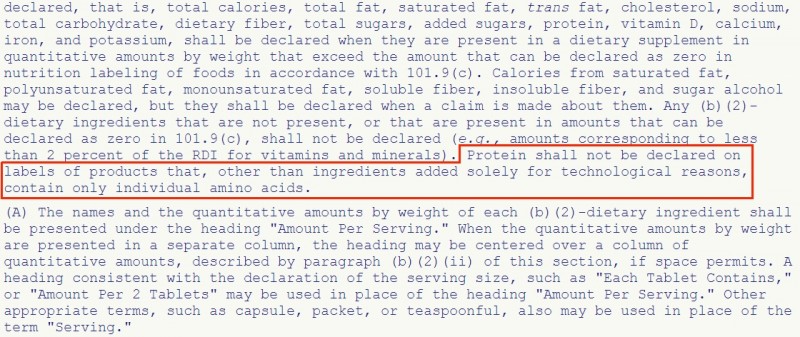
  1. the FDA regulations state that supplement manufacturers can’t declare the protein content of a product when this only contains individual amino acids.
  2. the FDA regulations allow supplement manufacturers to calculate the caloric content of their products using a number of methods, including the Atawater method, which involves adding up the calories from protein (4 kcal/g), carbs (4 kcal/gram) and fats (9 kcal/gram).
Do-BCAAs-Have-Calories-Myolean-Fitness-FDA1.jpg

Do-BCAAs-Have-Calories-Myolean-Fitness-FDA2.jpg
 

madyogi

Moderator, Member of the Month April 2020, PEGym
Joined
Feb 20, 2020
Messages
1,179
Reaction score
42
Points
68
Location
Arkansas, USA
It's been a can of worms in IF and fitness for a while now..
I'll leave it up to you to decide as health organisations wont label it as food.

That's good stuff!

It still leaves open the question what impact the constituent amino acids have on the fasting state vs actually ingesting protein in the form of food or drink.

I'm doing research now on ancillary benefits to IF in general, then will circle around to this. I also want to stick a pin in the notion of positive nitrogen balance brought up by Dickinger early on in this thread. Plus, there's still some further analysis to come on the water fasting study posted by Pegasus.

Stay tuned, if you care!
 

closed297

Registered
Well Done !
Joined
Jun 24, 2020
Messages
444
Reaction score
1
Points
0
It still leaves open the question what impact the constituent amino acids have on the fasting state vs actually ingesting protein in the form of food or drink.

That it does...
Another massive debate or (Can of worms) heavily associated around fitness..

Stay tuned, if you care!

Nothing excites me more at this point in time..
 

madyogi

Moderator, Member of the Month April 2020, PEGym
Joined
Feb 20, 2020
Messages
1,179
Reaction score
42
Points
68
Location
Arkansas, USA
Earlier in this thread, the following question was asked of me : "Do you personally partake in it because you get other positive effects?"

My answer at the time was I mostly partake in it for lifestyle reasons. It works better for me to think about calories in terms of week-to-week rather than day-to-day or meal-to-meal. As mentioned in the John Berardis interview, IF protocols bias toward the week-to-week style thinking, so it fits better with my general approach.

In response to that same question, I mentioned others have made claims that intermittent fasting has other ancillary benefits outside just making caloric deficit (or balance) easy for those who like it. I also mentioned the science is shaky. I'm going to concentrate my next few posts on trying to find out just what those benefits might be, and just how shaky the science is or isn't.
 

closed297

Registered
Well Done !
Joined
Jun 24, 2020
Messages
444
Reaction score
1
Points
0
It still leaves open the question what impact the constituent amino acids have on the fasting state vs actually ingesting protein in the form of food or drink.

I'd like to add my opinion on this even though it isn't really the OP's intention..

Supplements are usually just a version or concentrated extract of what's already available in certain foods or drink..
So to address this there would be 2 elements to address
1. Convenience- Often supplements are far more convenient as the specific extract is far easier to consume for the desired result.. This may also allow you to achieve the exact portion of the "nutrient" you are looking to add to your dietary needs without consuming added products that associate with the natural version..
This comes in particularly handy if your watching your diet extremely closely..
Often this is crucial to performance..
2. Which nutrients you want EXACTLY to be present in your body..
A perfect example to this would be... Should i take a vitamin c tablet or eat an orange?..
ORANGE:
Amount Per 1 fruit (2-5/8" dia) (131 g)
Calories 62


% Daily Value*
Total Fat 0.2 g0%
Saturated fat 0 g0%
Polyunsaturated fat 0 g
Monounsaturated fat 0 g
Cholesterol 0 mg0%
Sodium 0 mg0%
Potassium 237.1 mg6%
Total Carbohydrate 15 g5%
Dietary fiber 3.1 g12%
Sugar 12 g
Protein 1.2 g2%
Vitamin A5%Vitamin C116%
Calcium5%Iron0%
Vitamin D0%Vitamin B-65%
Cobalamin0%Magnesium3%


If i eat the orange there are multiple other nutrients included in the process that i may want to avoid or on the contrast may want to include.. as an example i will use the carbs (15g) or the sugar (12g)..
A vitamin c tablet will be labeled as containing 0% of all other nutrients accept vitamin c..
Ingredients

Ascorbic Acid (Vitamin C) 250 mg
Sodium Ascorbate (equivalent Ascorbic Acid 250mg) 281mgContains: NO ADDED: Gluten, lactose, sugar, artificial flavours, artificial preservatives, dairy products or animal-derived products


The diabetic may opt for the tablet as he is looking to avoid the sugar (understandably so)
On the flip side a person may want that 12g of natural sugar to be part of his daily requirement..(also a rational thought)

In my opinion it really doesn't matter which one you choose..
But i also have a slight trust that science is there to benefit and aid me.. (There are people who do not)