

Intermittent Fasting Protocols and Muscle Sparing

madyogi

Moderator, Member of the Month April 2020, PEGym
Joined
Feb 20, 2020
Messages
1,179
Reaction score
42
Points
68
Location
Arkansas, USA
So, between the Mad Yogi vs The Burrito Contest and the Evidence of Type 2 Diabetes Reversal threads, there has been a fair bit of discussion onsite about the benefits and potential drawbacks of calorie restriction diets and various forms of exercise. Pegasus and I have gone back and forth via PM about whether or not Intermittent Fasting (IF) protocols by necessity lead to muscle loss. He has anecdotal evidence that people he knows have visibly lost muscle mass while engaging in such protocols, and I have anecdotal evidence that I have not experienced muscle loss while on such protocols. I know we have other fitness/nutrition buffs onsite, so I thought it might be worthwhile to start a thread about this subject.

As a starting point, I am linking to an article from healthline called Does Intermittent Fasting Make You Gain or Lose Muscle? It's a solid article that points to numerous studies, and also points out that IF protocols vary widely. It also points out that resistance training in conjunction with IF is critical if you want to spare and/or gain lean mass while engaged in calorie restriction. Further, it points out that calorie restriction is NOT recommended if gaining lean mass is your explicit goal. All of these things make sense to me intuitively and seem to be supported by the evidence.

So now to the details of two studies that support my hypothesis that IF protocols need not lead to a decline in lean mass.


To be fair, there are studies that show decreases in lean mass on IF-style protocols. My contention is that the evidence is mixed, and seems to indicate that the approach matters. It isn't that IF protocols must lead to the loss of lean body mass. It is more likely the case that the design of such protocols makes the difference between sparing/gaining lean body mass and losing it.

I have more to say about exercise protocols and macro-nutrient ratios for maximizing lean mass retention while restricting calories, but this should suffice to get the conversation going.
 
Last edited:

Dickinger

Registered
Well Done !
Joined
Jul 7, 2020
Messages
24
Reaction score
2
Points
23
I can sense, that this is going to be a super-interesting thread. I couldn't say I overlooked relevant research on this matter, but my gut feeling is:
- intermittent fasting is not the determinant of whether or not lean muscle mass is lost
- assuming one is exercising, the determinant should be, whether one is in a state of positive nitrogen balance (so that protein synthesis is occurring)
- if so, it is possible to be hypocaloric, losing fat and keeping lean musle mass (or even slowly increase it)
- I would personally work under the assumption, that intermittent fasting has certain benefits -- but in my thinking there is no difference, whether you are hypocaloric over the course of the day or over the course of your intermittent fasting eating window

But I have to admit, that I'm not speaking from personal experience, but I'm repeating the opinion of this gentleman (whom I think of as a very credible expert; he also manages to stay at or below 6% body fat all year while being pretty muscular). So he would argue:
- stay slightly hypocaloric
- exercise consistently
- find your personal amount of protein intake to achieve positive nitrogen balance
- prioritise recovery
(And make this a long-term lifestyle, so that one can stick with exercising and controlled calorie intake for the rest of one's life)

Back to intermittent fasting: I think it can provide extra benefits if used (and if this is suitable for you), but I wouldn't expect it to change the matters of gaining muscle mass and/or body fat loss. But I might be wrong. Would you know otherwise?
 

madyogi

Moderator, Member of the Month April 2020, PEGym
Joined
Feb 20, 2020
Messages
1,179
Reaction score
42
Points
68
Location
Arkansas, USA

madyogi

Moderator, Member of the Month April 2020, PEGym
Joined
Feb 20, 2020
Messages
1,179
Reaction score
42
Points
68
Location
Arkansas, USA
- assuming one is exercising, the determinant should be, whether one is in a state of positive nitrogen balance (so that protein synthesis is occurring)
- if so, it is possible to be hypocaloric, losing fat and keeping lean musle mass (or even slowly increase it)

This is interesting. I'll have to look more into the positive nitrogen balance piece, as I'm not familiar with it.

- I would personally work under the assumption, that intermittent fasting has certain benefits -- but in my thinking there is no difference, whether you are hypocaloric over the course of the day or over the course of your intermittent fasting eating window

You might be right, but the Intermittent vs Daily Calorie Restriction study linked to in the first post would seem to indicate otherwise.

Back to intermittent fasting: I think it can provide extra benefits if used (and if this is suitable for you), but I wouldn't expect it to change the matters of gaining muscle mass and/or body fat loss. But I might be wrong. Would you know otherwise?

My main argument is against the notion that fasting protocols may be great for losing weight and for improving metabolic markers related to conditions like Type 2 Diabetes, but that they necessarily lead to a loss of muscle tissue in the process. My contention is that, if done properly, such protocols need not waste lean body mass.
 

madyogi

Moderator, Member of the Month April 2020, PEGym
Joined
Feb 20, 2020
Messages
1,179
Reaction score
42
Points
68
Location
Arkansas, USA

Dickinger

Registered
Well Done !
Joined
Jul 7, 2020
Messages
24
Reaction score
2
Points
23
Only now I read at least the abstract of this study. It made me realise, that I can't make an educated statement on this level. However, the study's idea to toggle food intake on a daily basis just doesn't feel "right"/healthy to me. Your protocol, however, sounds like a good plan to me, because you seem to combine the best out of different good approaches.


My main argument is against the notion that fasting protocols may be great for losing weight and for improving metabolic markers related to conditions like Type 2 Diabetes, but that they necessarily lead to a loss of muscle tissue in the process. My contention is that, if done properly, such protocols need not waste lean body mass.
Great statement! I wish for this to turn out solid, because that would be a very hopeful + positive perspective and a great option for people - anyway it does sound "right" to me.

One more study -- Effects of resistance vs. aerobic training combined with an 800 calorie liquid diet on lean body mass and resting metabolic rate -- showing that resistance training combined with a Very Low Calorie Diet (VLCD) yielded no lean body mass loss, while aerobic training combined with VLCD did cause lean body mass loss.
Again I only read the abstract, but that is indeed a very interesting find. I wasn't aware, that you could go down this much with your calorie intake and that there could still be a way to keep up lean body mass, regardless. Another piece of research, that appears to be suited to give people hope and a positive perspective. :)

So now all that is missing, would be, that we people apply only a mere 10% of all that goodness, right? :rolleyes:
 

madyogi

Moderator, Member of the Month April 2020, PEGym
Joined
Feb 20, 2020
Messages
1,179
Reaction score
42
Points
68
Location
Arkansas, USA
So now all that is missing, would be, that we people apply only a mere 10% of all that goodness, right? :rolleyes:

If you're smart about what you do, you can generally get 80% of the benefits by doing 20% of the right things (pareto principle). The trick is finding the 20% that really works for you and focusing on that.
 

Pegasus

Administrator, PE Gym Editor, PEGym Hero; ,
Staff member
Excellent !
Joined
Jul 15, 2009
Messages
44,283
Reaction score
1,164
Points
133
I would like to ask a question. Which if any of these studies used a high quality method to measure lean body weight ?

So to the quality of Dexa or hydrostatic . If they used some low quality method like electrical impedience the results are basically worthless especially given the low numbers.
 

madyogi

Moderator, Member of the Month April 2020, PEGym
Joined
Feb 20, 2020
Messages
1,179
Reaction score
42
Points
68
Location
Arkansas, USA
I would like to ask a question. Which if any of these studies used a high quality method to measure lean body weight ?

So to the quality of Dexa or hydrostatic . If they used some low quality method like electrical impedience the results are basically worthless especially given the low numbers.

It will take me a bit to look back through the methodologies, unless you'd like to do it yourself. Do you have studies to present that use such methods and refute the studies presented here?
 

Pegasus

Administrator, PE Gym Editor, PEGym Hero; ,
Staff member
Excellent !
Joined
Jul 15, 2009
Messages
44,283
Reaction score
1,164
Points
133
Not interested in wasting more time on this .
Here if you want you can check the methodology on this one also.

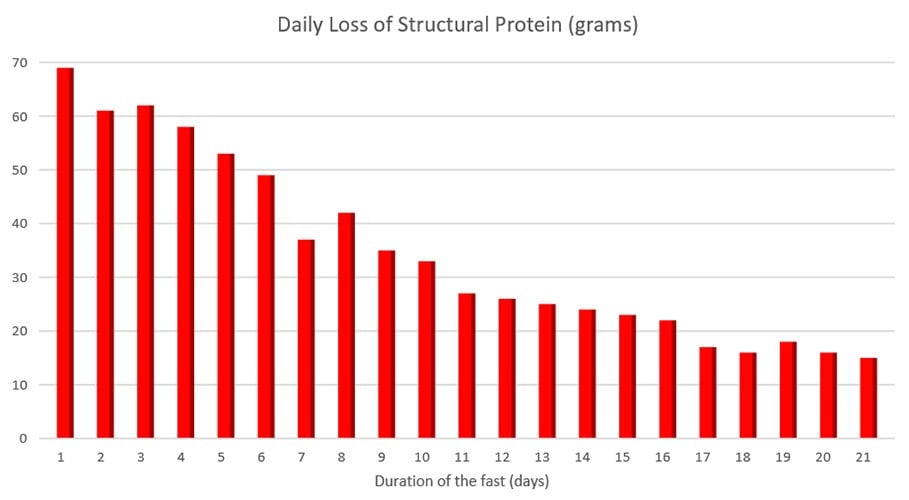
[h=2]The daily loss of structural protein on a water fast[/h]In one starvation study [3], they measured the amount of protein obese people lost during a 21-day water fast.
I’ve adapted the data from that study into this daily protein loss chart:
daily-loss-protein-water-fasting.jpg
You can see that on the 1st day of the water fast (the first bar on the left), the loss of structural protein was the highest (69 grams).
By the end of the 21-day fast (the last bar on the right), the loss of structural proteins was reduced by almost 80% (to 15 grams).
This shows that our bodies can adapt to starvation extremely well. In order to keep you alive as long as possible, your body keeps slowing down the destruction of your vital body mass.


[h=4]⌄ Scroll down to continue reading article ⌄[/h]


[h=1][COLOR=inherit !important]Are You Not Getting Enough Exercise?
[/h]


Stay Fit While Staying Home with Lifehack's FREE Workout Plan!
 

madyogi

Moderator, Member of the Month April 2020, PEGym
Joined
Feb 20, 2020
Messages
1,179
Reaction score
42
Points
68
Location
Arkansas, USA
I would like to ask a question. Which if any of these studies used a high quality method to measure lean body weight ?

So to the quality of Dexa or hydrostatic . If they used some low quality method like electrical impedience the results are basically worthless especially given the low numbers.

So, the meta-analysis that was of most interest to me - - notes the following:

It is important to note, however, that comparing values for fat mass and fat free mass between studies is difficult as different techniques were employed to assess these parameters. More specifically, the majority of daily CR trials implemented dual‐energy X‐ray absorptiometry (DXA) and magnetic resonance imaging (MRI), while the majority of intermittent CR trials employed bioelectrical impedance analysis. It is well known that DXA and MRI are vastly more accurate techniques for the assessment of fat mass and fat free mass when compared to bioelectrical impedance analysis. Thus, the different methods employed could create variability when comparing findings between diets.

So, probably a mixed bag, but certainly many of them did use your preferred testing methods. It's also worth pointing out that their findings were indeed that both methods lost lean body mass, but that the intermittent studies showed significantly less (0-4% loss range as opposed to 2-8% loss range). This meta-analysis made no note of whether resistance training was involved, and it's my belief that resistance training would have to be part of the routine to spare lean mass.
 

closed297

Registered
Well Done !
Joined
Jun 24, 2020
Messages
444
Reaction score
1
Points
0
I can't see from a scientific standpoint how fasting of ANY variety could promote muscle mass..

The core process of building muscle is protein synthesis which requires (obviously protein to be present in the body among many other things)..

As most of us know there are recommended amounts of how much protein you need to promote muscle growth or retention (obviously dictated by age, hormones,activity ect..)

However if your metabolism is slow there is a chance that you could fast without losing muscle mass or even gaining it.

Surely that would have more to do with the fact the nutrients required was present though?

That MAY be why SOME results go in the favour of fasting and retaining..

There is no reason why ANY method can't work per say.. (including fasting)

But at a guess i would imagine "odd" genetics play a massive role in determining whether or not someone can skew from the mainstream methods, science and medical (dietitians) use with success.

And for the record
(And make this a long-term lifestyle, so that one can stick with exercising and controlled calorie intake for the rest of one's life)
AMEN !

Also he is actually extremely accurate about this

So to the quality of Dexa or hydrostatic . If they used some low quality method like electrical impedience the results are basically worthless especially given the low numbers.

Worthless doesn't begin to describe electrical impedance

These studies would be much more efficient if they used bodybuilders or athletes because the effects would be more extreme leading to larger variations and more noticable changes.. (which their job is to address this or at least their nutrients coaches)

If you do some research on sports nutrition you would be disgusted at how immaculate their diet needs to be even with the use of steroids even more so if they wish to compete naturally (Hence why so many opt to take health endangering substances for an advantage)

There is a good reason not anyone can just grab a football and be a superstar.. (And a lot of the time talent is second string to dedication)

Monitoring the average obese guy is a poor indicator in my opinion...

Also
Not interested in wasting more time on this .
You should be open to discuss something if you have a strong opinion about it :)
 
Last edited:

madyogi

Moderator, Member of the Month April 2020, PEGym
Joined
Feb 20, 2020
Messages
1,179
Reaction score
42
Points
68
Location
Arkansas, USA
I can't see from a scientific standpoint how fasting of ANY variety could promote muscle mass..

I'm not making the case that fasting promotes muscle mass. I'm making the case that IF protocols when implemented properly need not lead to long-term muscle loss, and can be coincident with muscle gain.

Monitoring the average obese guy is a poor indicator in my opinion...

I would agree with this. Unfortunately, much of the money to fund research of this sort is attached to addressing major public health issues like obesity and diabetes.
 

closed297

Registered
Well Done !
Joined
Jun 24, 2020
Messages
444
Reaction score
1
Points
0
I'm not making the case that fasting promotes muscle mass. I'm making the case that IF protocols when implemented properly need not lead to long-term muscle loss, and can be coincident with muscle gain.

This addresses this specifically..

However if your metabolism is slow there is a chance that you could fast without losing muscle mass or even gaining it.

Surely that would have more to do with the fact the nutrients required was present though?

That MAY be why SOME results go in the favour of fasting and retaining..

There is no reason why ANY method can't work per say.. (including fasting)

That's my opinion on the matter..

The real question behind all this how long until a pill replaces all diets that has the required nutrients for any goal..
At Least in sports..
I mean if they can ether testosterone to administer a 3 month dose surely they can do this with nutrients in food?
It may even be a 3 month nutrients injection one day :p

And then the next question.. would you take the "pill" or "injection" if it supplied your body with optimal nutrients..
At the sacrifice of enjoying food.

I'd also like to add on for OP sake a great person to ask would be any strength and conditioning coach from any large sporting club ANYWHERE in the world as they would specifically study what methods are the most effective and they are dealing with MILLIONS of dollars of resource to do so.

Not to mention when money is involved (the elite level) even a 1% advantage could be the difference between potentially millions in revenue..

Like for example a boxer using a strength and conditioning coach would surely investigate all possible avenues when they need to perform their "cut" stage to weigh in.. they would most likely know the optimal ways to avoid strength and muscle loss.. (which i'm assuming would coincide with retention)

They would most likely also know the cheat ways and ANY way its possible and which works best..
 
Last edited:

madyogi

Moderator, Member of the Month April 2020, PEGym
Joined
Feb 20, 2020
Messages
1,179
Reaction score
42
Points
68
Location
Arkansas, USA
The real question behind all this how long until a pill replaces all diets that has the required nutrients for any goal..
At Least in sports..
I mean if they can ether testosterone to administer a 3 month dose surely they can do this with nutrients in food?
It may even be a 3 month nutrients injection one day :p

And then the next question.. would you take the "pill" or "injection" if it supplied your body with optimal nutrients..
At the sacrifice of enjoying food.

This is an interesting question to consider, but off topic. Perhaps start another thread to discuss this if you like.

I'd also like to add on for OP sake a great person to ask would be any strength and conditioning coach from any large sporting club ANYWHERE in the world as they would specifically study what methods are the most effective and they are dealing with MILLIONS of dollars of resource to do so.

Not to mention when money is involved (the elite level) even a 1% advantage could be the difference between potentially millions in revenue..

Like for example a boxer using a strength and conditioning coach would surely investigate all possible avenues when they need to perform their "cut" stage to weigh in.. they would most likely know the optimal ways to avoid strength and muscle loss.. (which i'm assuming would coincide with retention)

They would most likely also know the cheat ways and ANY way its possible and which works best..

I kinda disagree with this. I'm not talking about THE BEST way to do anything here. I'm making a specific claim that Intermittent Fasting protocols if properly implemented need not lead to lean body mass loss over time. That's it. It's a very specific claim.

Notice I'm not saying fasting in isolation doesn't lead to short term lean mass loss. Notice I'm not saying Intermittent Fasting is the best way to put on muscle mass, or lean down before a body building competition or whatever.

Given the evidence I'm finding, it's likely that if you're doing caloric restriction to lose weight in something of a sprint, an Intermittent Fasting protocol combined with resistance training, is a better way to go than daily caloric restriction combined with strictly aerobic exercise. I'm surprised people find these claims to be so controversial or off base.

The study Pegasus referenced in Post #10 is interesting for a number of reasons, but it still doesn't refute my actual premise. Notice, again, I'm not saying if you fast you won't lost some lean mass in the short term. An interesting thing about that study that isn't in the graph Pegasus posted is that it doesn't show you the measurement from Day 0 (the measurement taken after an overnight fast, prior to day 1 of the water fast regimen).

Day 0 showed a loss of ~33 g of structural protein, which is to say you lose structural protein even during the normal 10-12 hour sleep cycle fast. That 69 g loss after day 1 of water fasting is basically double what you would lose normally, even after a day of eating. I need to do some more analysis on the study before I say too much more, so stay tuned for that if you're interested.

The bottom line is I'm not so concerned with structural protein loss from day to day. I'm concerned with net structural protein loss from week to week or month to month. This study appears to have nothing to say about whether Intermittent Fasting protocols have a negative effect on the latter.
 

closed297

Registered
Well Done !
Joined
Jun 24, 2020
Messages
444
Reaction score
1
Points
0
The bottom line is I'm not so concerned with structural protein loss from day to day. I'm concerned with net structural protein loss from week to week or month to month. This study appears to have nothing to say about whether Intermittent Fasting protocols have a negative effect on the latter.

Why would one study the long term effects of this? (asking because is it a realistic thing to expect conclusive results?)
Also wouldn't it be extremely subjective to the length of fasts...
The amount of nutrients available from previous dieting (how full they are).
The average calorie intake prior to fasting
The speed of their metabolism <-- i'm assuming this is crucial

What i'm getting at is a "study" like this would have so many variables (like most dietary studies) as you have stated in previous threads nutrition is extremely subjective and adverse for many reasons (age,hormones,metabolism,activity,diet,goals,gender to name a few)

I've personally when bulking (This is advice from a professional bodybuilder) purposely eaten oatmeal before sleeping to assure optimal protein synthesis..
Purposely utilising the slow release carbohydrates and protein..

The reason i mention this specifically if one was to eat something similar than this prior to fasting the nutrients would linger for hours depending on the subject..
So how close are these "studies" going to get?

There are plenty of websites that promote intermittent fasting as a regular part of a bodybuilding routine (So if we're talking retention it shouldn't be a problem)
Even websites who claim scientific backgrounds (PHD's) that promote its use.

I would enjoy seeing a study on this as much as you.. as i'm not opposed to changing my techniques if proven effective.
And i use the word proven in terms of either meeting someone at the professional level following or trying their advice (hoping they are not pulling my leg) or if science were to a do a conclusive study on the matter with large numbers (which is kinda of getting into medical territory)

I don't disagree that it cannot be used to benefit one's health (fasting)..But i also think it isn't necessary..

Given the evidence I'm finding, it's likely that if you're doing caloric restriction to lose weight in something of a sprint, an Intermittent Fasting protocol combined with resistance training, is a better way to go than daily caloric restriction combined with strictly aerobic exercise. I'm surprised people find these claims to be so controversial or off base.

I agree with this..I don't find it controversial.

If you specifically want to know if you CAN do it because you WANT to while maintaining muscle mass there are PLENTY of people who do it and would take your side in this discussion and promote its use. Some even suggest (and certified) that it promotes muscle strength..

I just fail to see why you HAVE too (If you like it then why not).. i won't deny many use it and get positive results..
However if someone asked me for a dietary plan as a pt i wouldn't put it in as my first choice.
If they specifically asked me to include it..i would be more than happy to incorporate its use.

Question: Do you personally partake in it because you get other positive effects? Or is it strictly because you see better results?

Here's a link if allowed to an example of someone who fasted to positive results.. And recorded the results..

https://www.t-nation.com/diet-fat-loss/john-berardis-great-fasting-experiment (if its not let me know and il copy paste the text instead)

He's also a doctor and a bodybuilder if that helps credify the experiment..He also promoted with the experiment on his clients on top of his own body.
 
Last edited:

Pegasus

Administrator, PE Gym Editor, PEGym Hero; ,
Staff member
Excellent !
Joined
Jul 15, 2009
Messages
44,283
Reaction score
1,164
Points
133
I don't know how relevant obese women are to the rest of us .

When I asked the question of the dietican and the exercise physio who deal with athletes day in and out and whose job it is to measure record and promote things like muscle ., their response was any type of crash diet should be avoided and yes that definitely includes fasting .
 

Pegasus

Administrator, PE Gym Editor, PEGym Hero; ,
Staff member
Excellent !
Joined
Jul 15, 2009
Messages
44,283
Reaction score
1,164
Points
133
What is fasting anyway ?

If I go back to my childhood people regularly "fasted" for 12hr so they had dinner at 7pm and breaky at 7am that was a normal day for most people , an 18hr"fast "would have been missing a meal. People would have only considered it fasting if it went more than a day .

In a sense this IF stuff is just geting back to th way our grandparents ate .

Look I just want to say here my experience is that it is not only money that bends science , ideaology does also .
 

closed297

Registered
Well Done !
Joined
Jun 24, 2020
Messages
444
Reaction score
1
Points
0
I don't know how relevant obese women are to the rest of us .

When I asked the question of the dietican and the exercise physio who deal with athletes day in and out and whose job it is to measure record and promote things like muscle ., their response was any type of crash diet should be avoided and yes that definitely includes fasting .

Yeah you wont get a doctor recommending it..
Bit i think yogi is saying it can work for some..
I think he acknowledges doctors and scientist are yet to investigate it thoroughly (most likely never will)..

As i said in my first comment i can't see scientifically how not providing your body with nutrients at every possible opportunity.. Could be helpfull. (The premise of most science and medical advice).

You should also both note this "fad" and lets be honest it's still at the fad stage..

Is a very young concept. (There is room for expansion or expulsion)

If you read that article it reiterated in far better words what i'm trying to say..

What is fasting anyway ?

If I go back to my childhood people regularly "fasted" for 12hr so they had dinner at 7pm and breaky at 7am that was a normal day for most people , an 18hr"fast "would have been missing a meal. People would have only considered it fasting if it went more than a day .

Valid point and if you go back to hunter gatherer (1000's) of years i'd imagine you would have to make use of food for DAYS.
I agree that there is a reason science and medical advice leans towards multiple meals during the day to promote weight loss :)
 
Last edited:

Pegasus

Administrator, PE Gym Editor, PEGym Hero; ,
Staff member
Excellent !
Joined
Jul 15, 2009
Messages
44,283
Reaction score
1,164
Points
133
Actually fasting is a very old concept . It is the IF version that is relatively new and like I said you don't have to go back very far and it would be considered a normal day .

I actually think it can have health benifits . The problem I have is people keep saying you wont lose muscle even doing a great deal of this . Now I have been doing 12hr now and again but don't call that "fasting" it doesn't seem to cause a loss of muscle or fat. However like I said that is not much of anything lets look at a guy who is more serious .
I know a guy we will call Andy . Now Andy was a big guy liked hunting fishing and sometimes his work is physical ,,not a young guy but could still run through the bush with the dogs chaseing hogs . Trouble is he liked a feed so for a guy who did not do weights he carried a lot of muscle but also a lot of fat . So the doc wants to put him on meds for diabites 2. So Andy decided to change his life around and joined the gym and started IF . Now he is over a year in his blood sugar is great and his bodyweight has stabilised 50kg dowm so that is 110 lb. At times it has been more . Now he went through times of exhaustion where he draged himself to work and he lost strength . On talking to him he sees health improvement but here is the funny thing he says fasting does not cause muscle loss . Well hell I can see very clearly that he has he just doesn't want to admit it . The sort of guy he is I didn't push it and decided I would not mention the strength loss . To be honest though of he has regained a lot of the strength but then he has gone from not doing weighst to doing weights . Thing is a guy going from not doing weights to doing weights will normally gain muscle and strength .

Bottomline the guy improved his health but did he lose muscle yes he did, lost a lot of fat also. Now remember he lost muscle despite starting gym for the first time . Now this guy didn't do a 12 hr fast once a week he went hard .
A guy doing a 12 hr fast once a week I would not expect to do much of anything .
 
Last edited: